It’s 1810 Marmalade week!

Back in 2011, my first ever publication (long since out of print alas) was The 1810 Cookbook, a new edition of a recipe collection pulled together by Jane Onslow, my 4 x great grandmother, on the occasion of her marriage to Edward Winnington-Ingram in 1810. It is long since out of print but I still use the original to cook from. And one of the best recipes it contains is for this Seville Orange marmalade. Jars of pure sunlight.
The W-Is were church gentry – and Jane, daughter of the Dean of Worcester, whose portrait suggests she enjoyed fine dining, moved with Edward into the family stately pile, Ribbesford House, which is currently for sale if you have a spare million and three times that as a restoration budget! 👇

Ribbesford House, Ribbesford, Bewdley | Property for sale | Savills https://share.google/T7QMse0KDveMhOcOG

Jane’s recipe collection shows how widely they sourced their food: macaroni ‘as at Naples’, Curaçao, curry powder, mock turtle soup, macarons and crême brulée for example.

To make this marmalade you will need a spare week, about 20 Seville oranges, an ample supply (3kg or so) of granulated sugar, plenty of good tapwater, a large preserving pan, a ladle, a spurtle or long wooden spoon (check it does not smell of onions), a jam funnel and a basin – or a handy clean bathtub!

In 1810 oranges from Seville would have been picked green and ripened in the holds of sailing vessels. Sevilles are small, rather dull fruits, never sold with the preservative wax which generally make an orange shiny today. This also means the fruits do not last as long, so marmalade season begins in December and will be over before the month of January is out.

A ship’s hold was probably not the cleanest of places, which is why the recipe begins with rather a strange instruction to modern eyes: to soak the fruit in a basin for three days, changing the water daily. I use our guest bath, well scrubbed before and after, for convenience! If you do this, the different layers of the orange soften and much of the bitterness gets washed away. Even in these modern times, it is remarkable how many tiny specks of grit get released from the skins during this three day process.
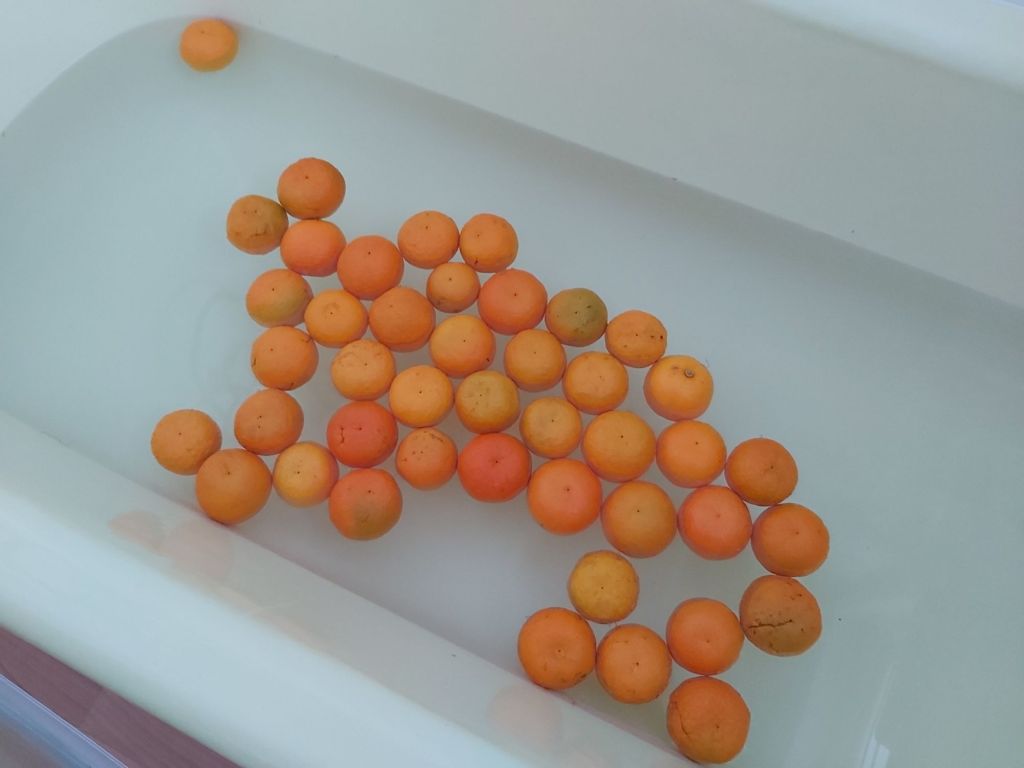
Yes, I scrub it first!

On day four, rinse the fruit one last time, drain and remove all the ‘eyes’ (where the stalk was connected) with a sharp pointed knife. You may need to clean or cut around this area.

Now chop each orange in half around its equator. Squeeze the juice into a bowl and set aside. Strain any pulp from the seedy discard and add to the juice bowl.
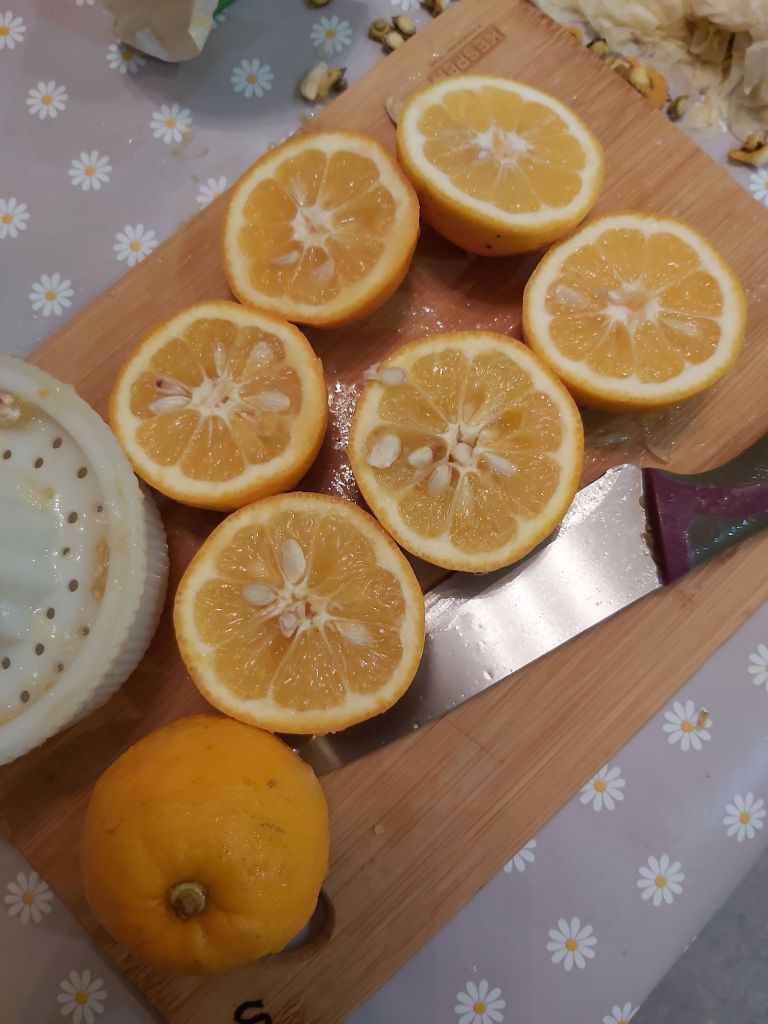
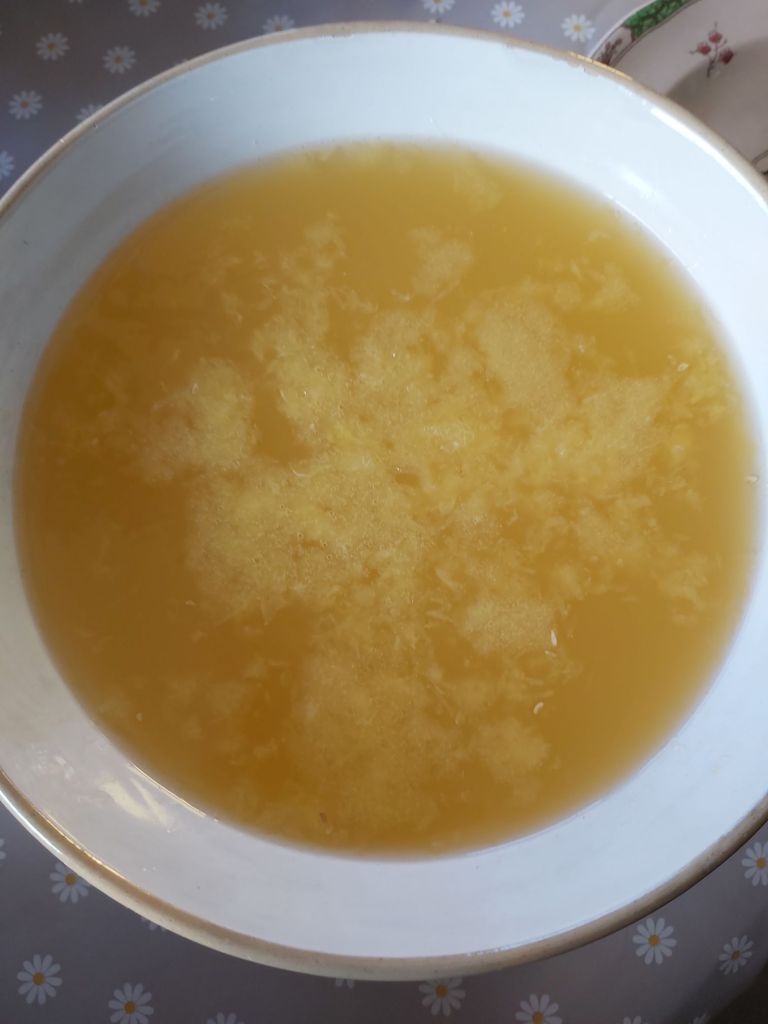
Lots of seeds. Some put these in a muslin bag and add them to the boil to aid setting but I don’t risk it.
Pulpy juice, sharp and sour.

Now chop the half oranges into quarters and place in a preserving pan. Cover with water and – yes, you’ve guessed it – leave to stand overnight. Taste this steeping water in the morning and it will still be bitter – these are not sweet oranges. Replace the water with fresh, covering the fruit. Bring to the boil, then simmer, covered, for about 20 minutes or until the zest yields to the tip of a knife but still has some resistance, but the pulp and pith are quite soft.

Place the quarters on trays and allow to cool and dry off overnight.

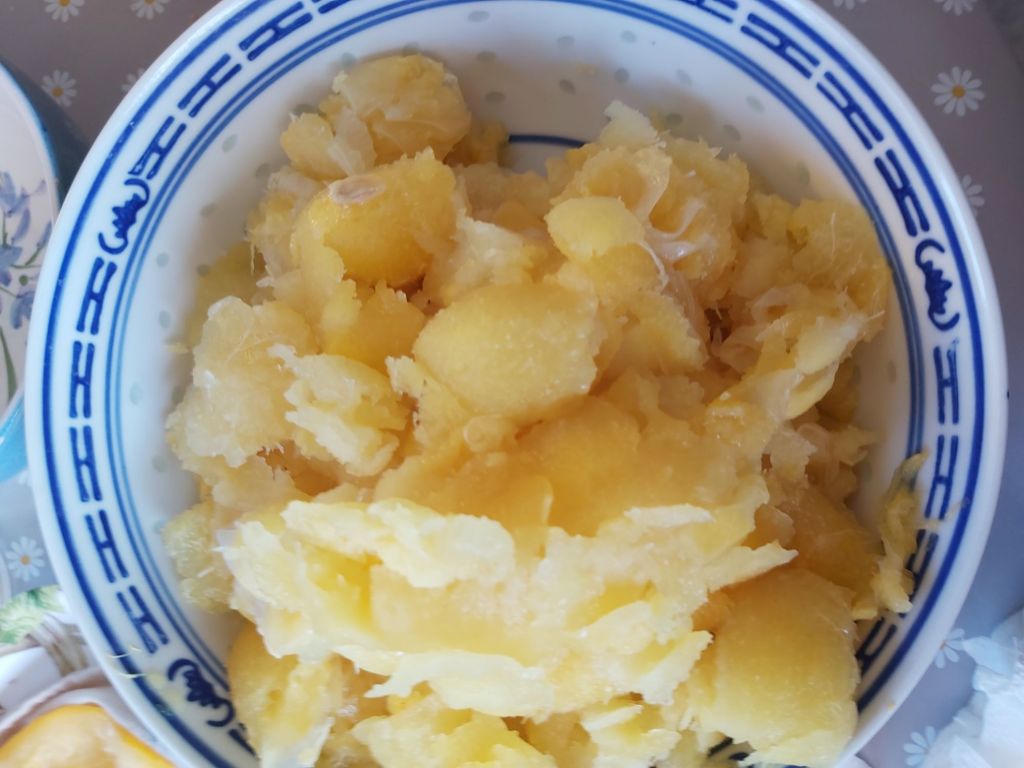
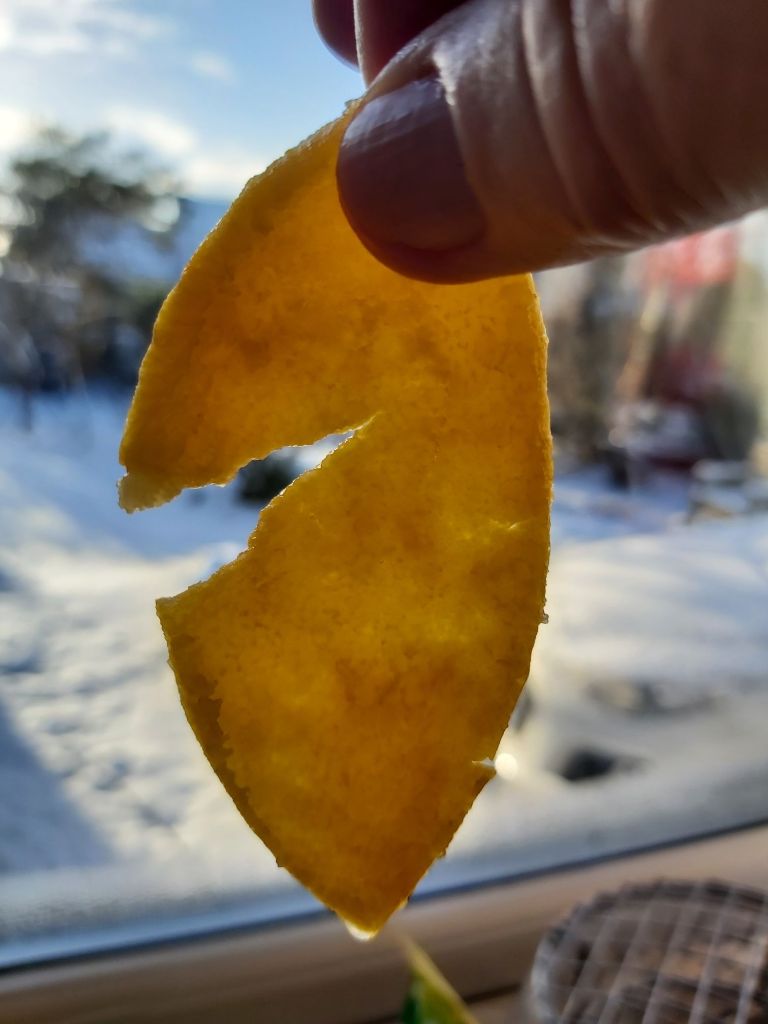
In the morning, scoop out all the pulp and strain it into the bowl of juice, then, with a sharp dessert spoon, scrape away and discard as much of the thick white pith as you can. You should now be able to see daylight through the skins.
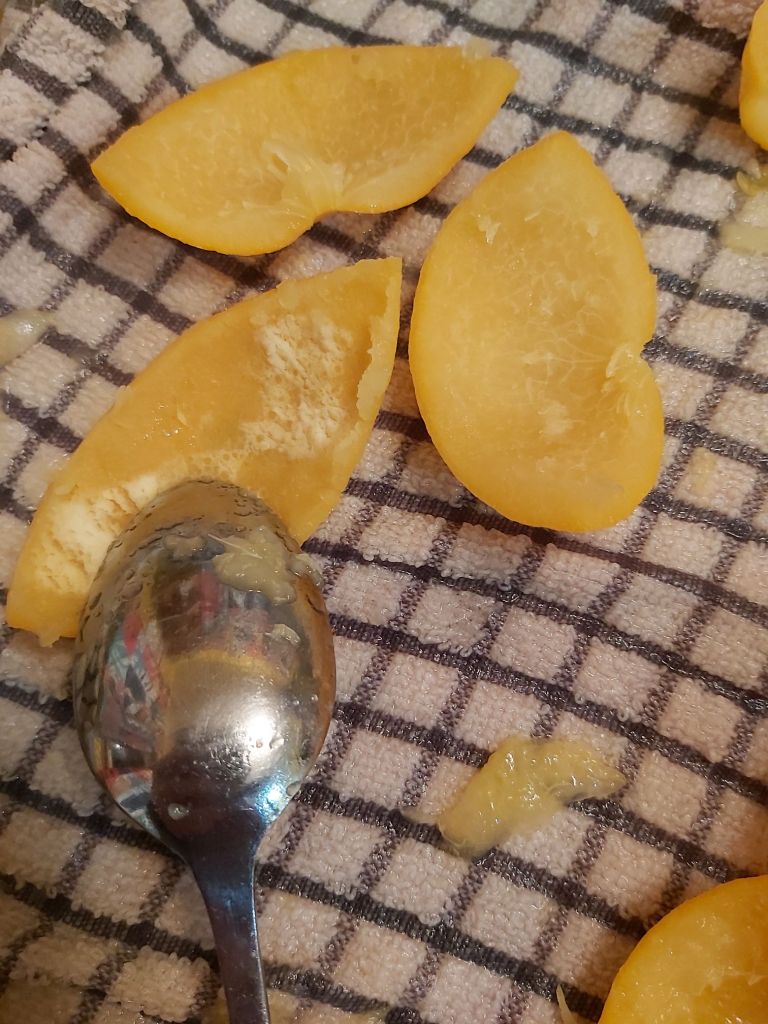
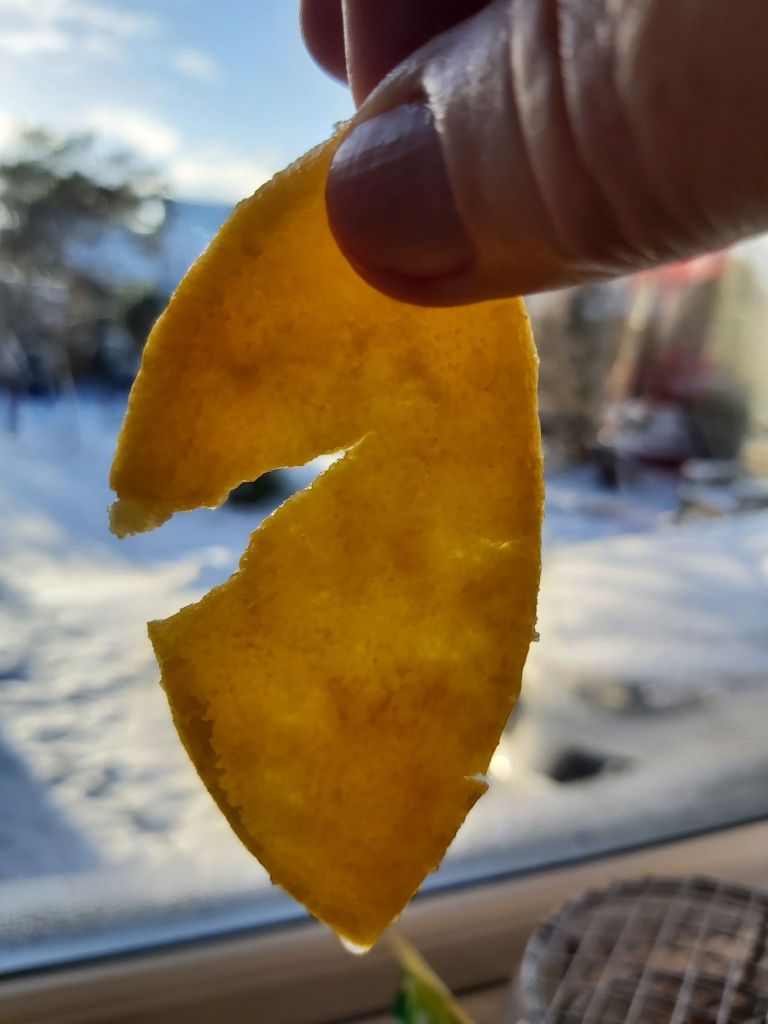
Scrape as hard as you can!
Daylight…
Discarded bitter pith – taste it, it’s awful!

Either with a sharp knife or with a pair of sharp kitchen scissors, cut these translucent zests into thin strips of varying lengths.
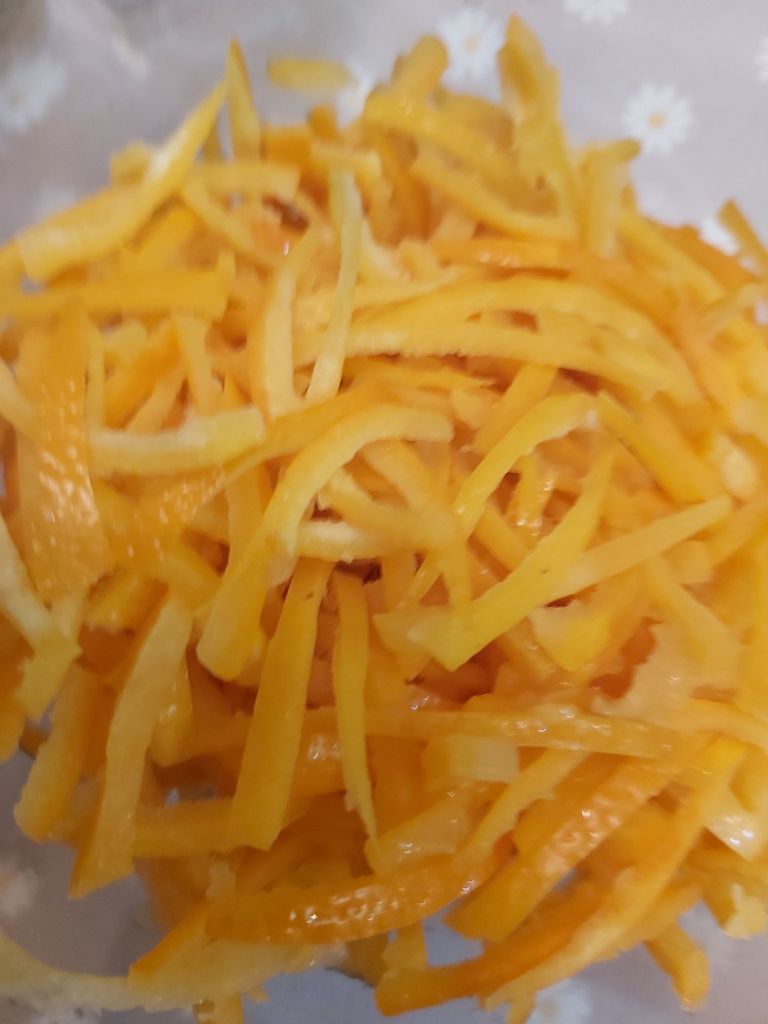
Much larger than lifesize!

I use a big measuring jug for the next bit. For every jug of shredded zest and every jug of juice, add a jugful of sugar to the preserving pan. Set aside to allow the sugar to dissolve, in theory overnight, but this particular corner I cut. Jane’s sugar would have been grated from a sugarloaf cone, so might have taken all night to break down. The main thing is to keep stirring it and not start to heat it until all the sugar has dissolved into the juice.

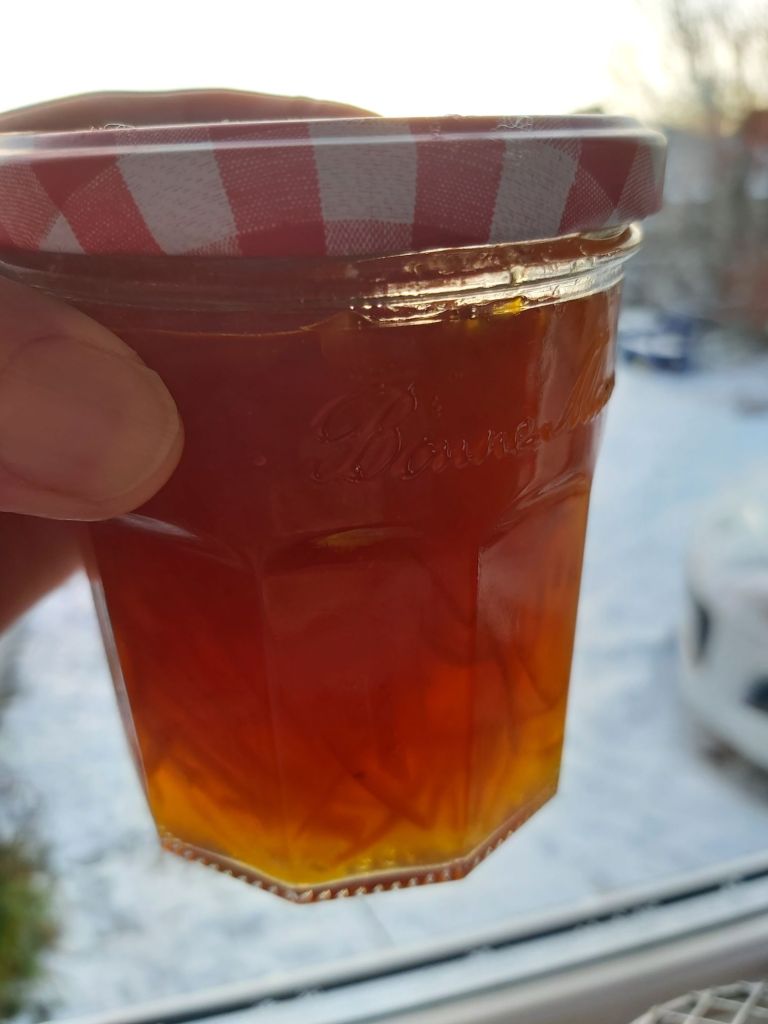
Now prepare your pots and lids. I like to use the commercial vacuum method, not faff around with circles of cellophane and elastic bands (sorry SWRI!), so good quality recycled jars like Bonne Maman are ideal. I made marmalade with 5kg of oranges this year and used 20 jars as shown. I run them through the dishwasher first, then pop them on a big baking tray with sides, along with my ladle and jam funnel, in the oven at 100 degrees.
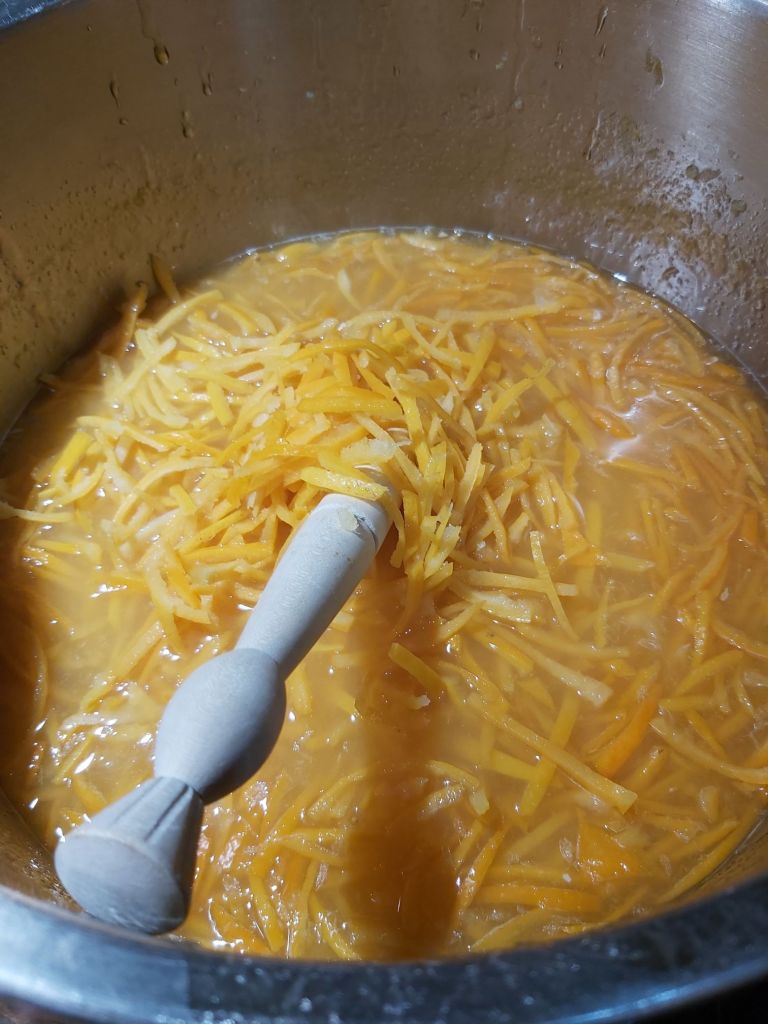
Back to your jam pan. Mine is a giant stainless steel pressure cooker base. You want a nice heavy bottom! I inch up the heat bit by bit until, after an hour, it comes to a rolling boil on maximum heat. Heat too rapidly and it will burn. Don’t be tempted to stick a finger in it to taste it, either, you’ll end up in Casualty!

At this stage the marmalade will be quite pale in colour and all the zest will be floating on top. Stir mixture frequently – I use a porridge spurtle.
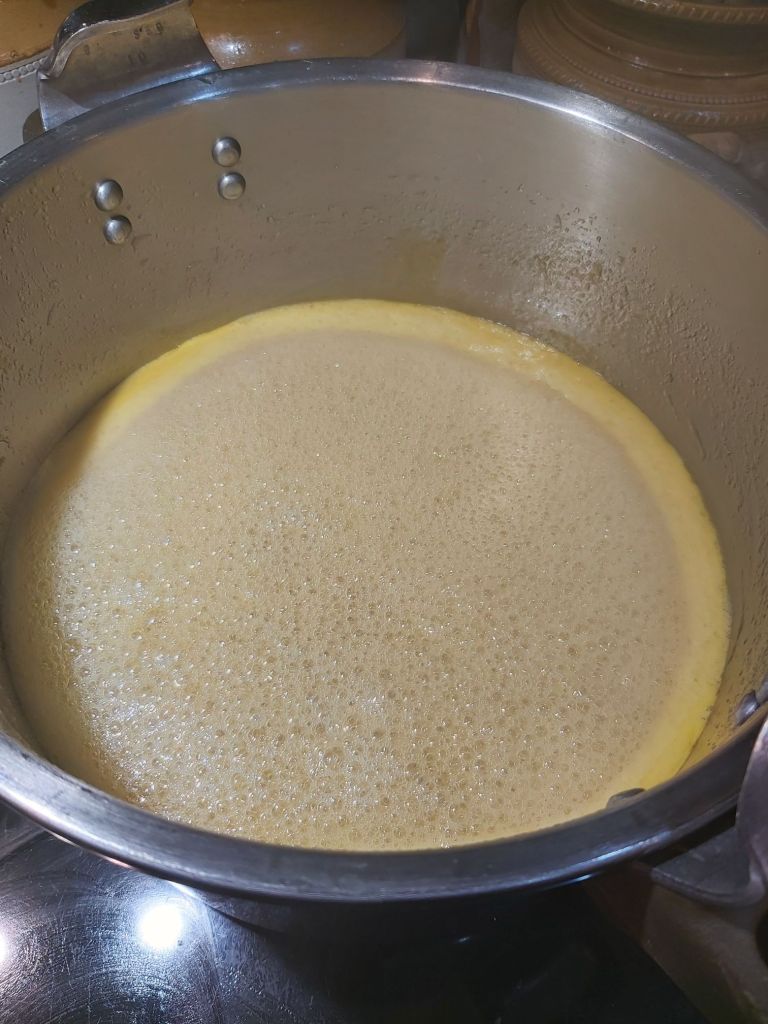
So hot it is difficult to get true colour because of steam!

Once a circle of yellow froth forms after about 20 minutes, skim off these impurities which will spoil the clarity of your marmalade (a good time to test the flavour, skimmings are delicious, impure or not!). Jane’s sugar probably had a few more impurities than Tate & Lyle does today.
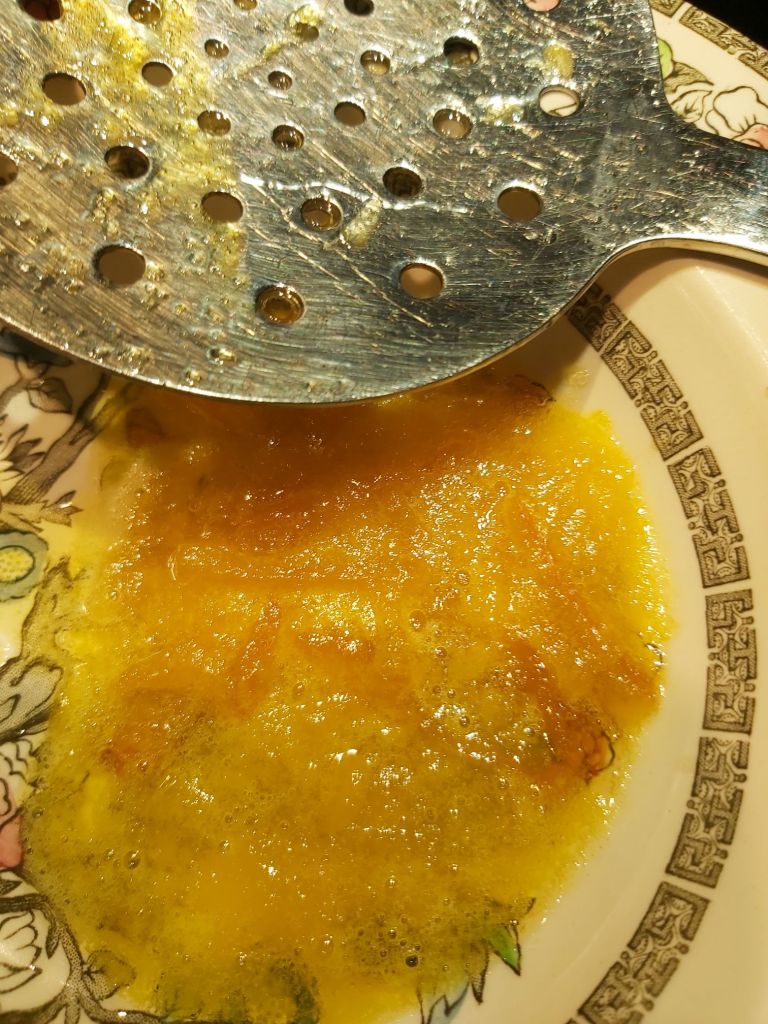
True colour

After a final 20 minutes or so, watch for three magical signs: the liquid reduces and starts to set on the sides of the pan, the colour and sound of the mixture deepens, and the bubbles become more glossy. When a little of the liquid starts to wrinkle when dripped on to a cold plate and tilted, pull your pan off the heat right away.
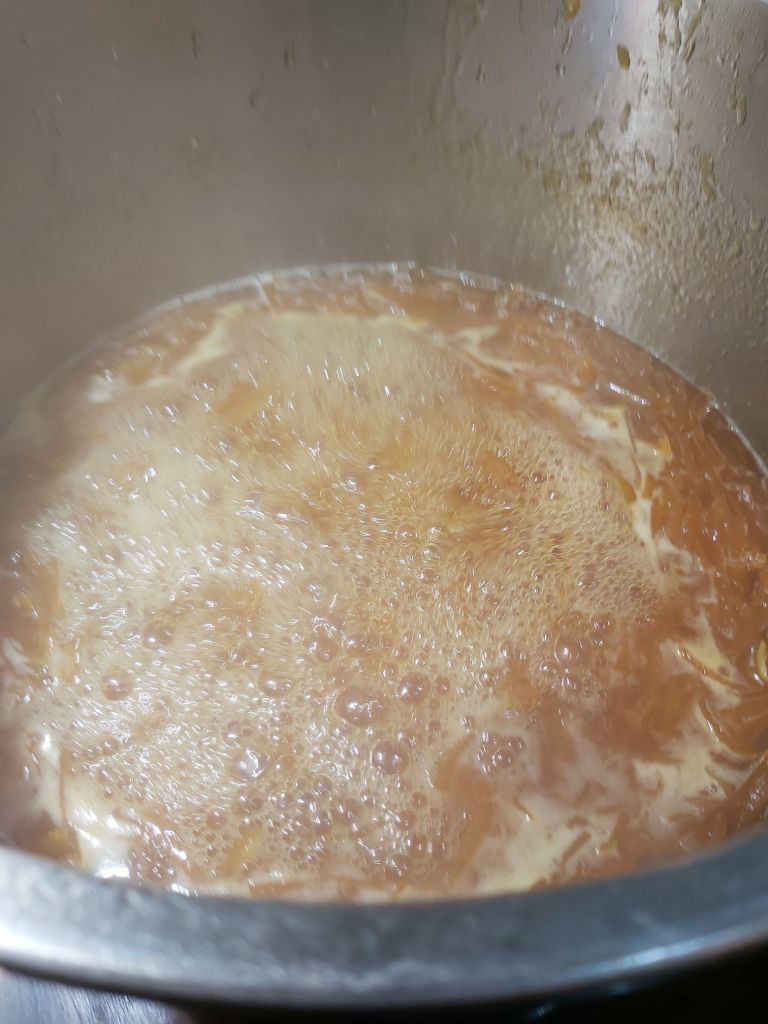
Again, true colour darker – too steamy!

Wearing washable or rubber gloves, ladle the hot marmalade into the hot jars. I added a nip of Scotch to part of my batch then poured the hot marmalade on to it. You can also add treacle and cut the skins more chunkily to make Dundee style marmalade.

Place lid on jar only loosely. Once all jars are filled and lidded, put tray of jars back in the oven for 15 minutes.
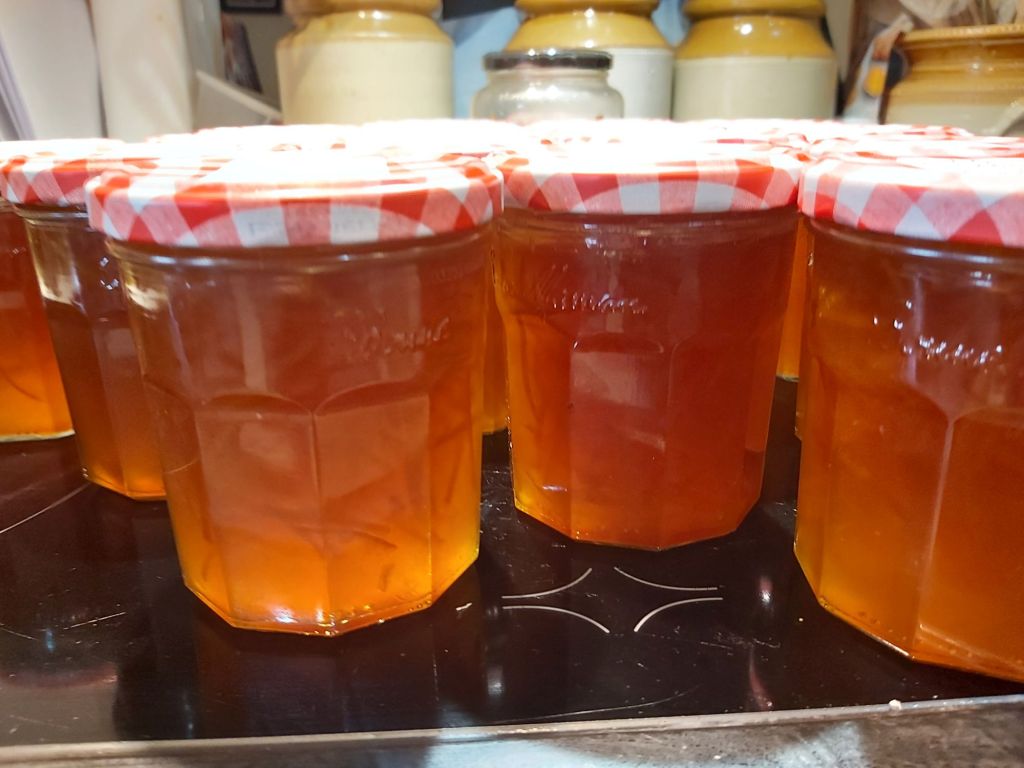
All that soaking makes sure the zest is distributed evenly

Tighten all the lids thoroughly and wipe any stickiness from jars. Allow to cool overnight – you’ll hear the pleasing ‘pop’ of the lids as the protective vacuum takes hold – then label and store. Will keep for a couple of years – if it gets the chance!
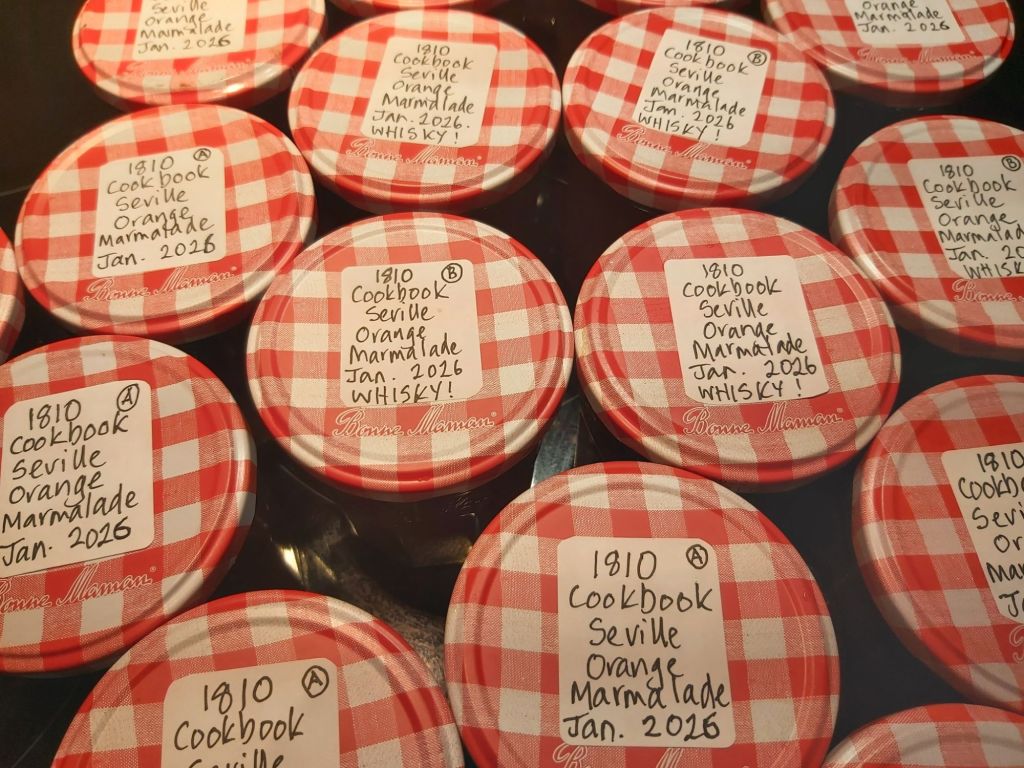
Guess who managed to label them all as Jan 2025 🤣

Thanks for reading this blog post. There are a few other recipes on here if you scroll back. Happy to answer queries and I would love to see pix of successful makes! I am on Threads as @veewalkerwrites and Facebook as Vee Walker.

You can still buy my novel Major Tom’s War (a WWI love and adventure story based on real people, including descendants of Jane and Edward W-I) and events in paperback or ereader from http://www.kashihouse.com.

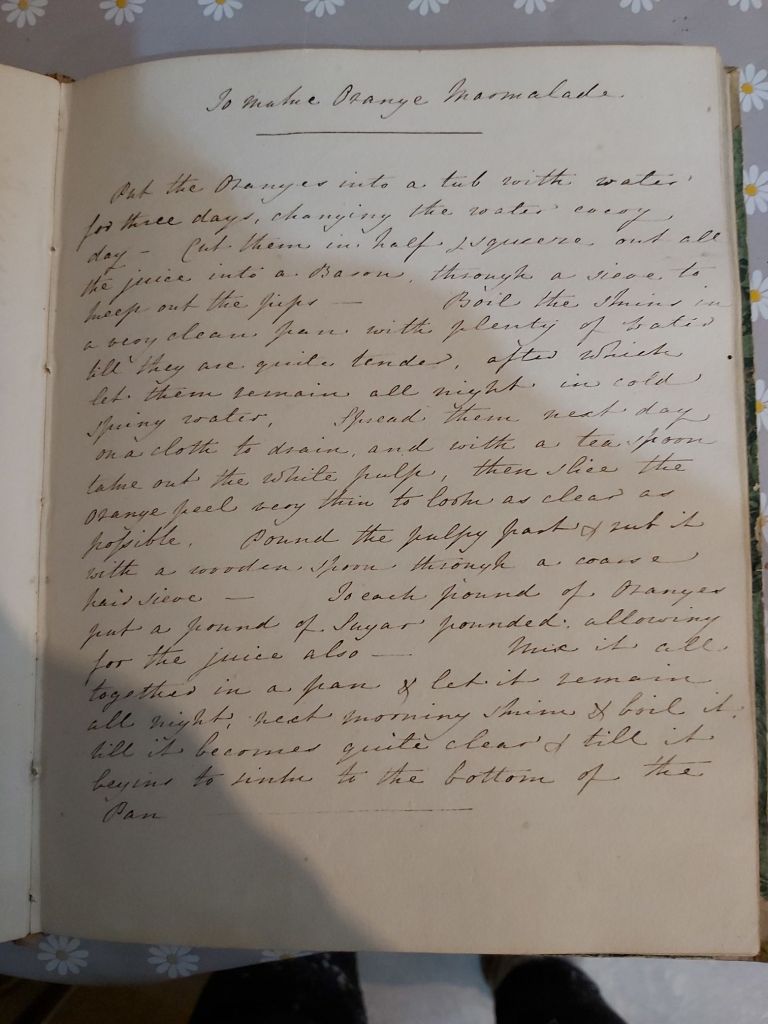
Here’s Jane W-I’s (cook’s, probably) original recipe, by the way 👇.
Happy marmalade-making!

Vee x
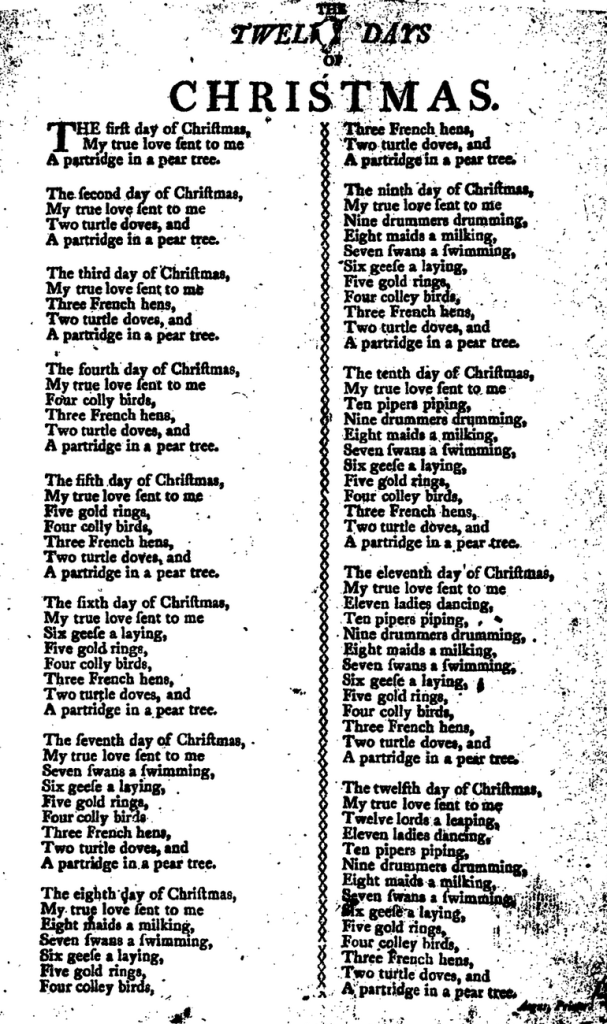
Feathery feasting for Twelve Days?

The earliest published version of The Twelve Days of Christmas dating from the late 1700s

A confession. I have never particularly liked The Twelve Days of Christmas. I prefer my carols bleakly midwinterish. Angels, a star, a manger, the baby, shepherds and three wise men: or failing those a bit of brightly berried pagan greenery. It did not help that at our local church we used to have to get up and sing the fatuous Twelve Days of Nonsense accompanied by witty gestures: extrovert heaven and introvert hell.

These Twelve Days of the Christian calendar begin on Christmas Day, December 25th and end on Twelfth Night, January 5th: the time of year when darkness and light struggle for symbolic and often literal supremacy. January 29th is the fifth day after Christmas – which in the carol offers that most nonsensical gift of all, five gold rings. I suppose the recipient could always melt them down, but really? And why the dramatic pause in the carol on this line in particular? That has always puzzled me – but recently I have stumbled on a solution.

I read somewhere a year or so ago that the carol might really be a celebration of birdlife. The RSPB has since had a good stab at which the ‘other’ birds might be here 👇 https://www.rspb.org.uk/our-work/rspb-news/rspb-news-stories/the-12-birds-of-christmas/

While all very interesting to birdlovers, this still does not explain why an ancient carol first sung long before binoculars were invented should have been written purely out of ornithological enthusiasm. It just seems to be a bit unlikely.

The Twelve Days was first published in the late 1700s but must have been sung for far longer. It is an example of a mediaeval cumulative song or rhyme (another is The House that Jack Built, inspiring more recent versions such as A. A. Milne’s The Royal Slice of Bread and Angelo Branduardi’s A la Foire de l’Est). In this early period of human history, people did not so much admire birds as eat them. Artists painted dead birds as gory still life. And dead game birds were frequent gifts, especially when times were hard. I still enjoy an occasional brace of pheasant.

The Twelve Days was a time of conviviality and feasting, supposedly after fasting (fasting is still a serious part of many world religions but it plays little part in modern western Christianity, as our UK obesity levels demonstrate. Ash Wednesday and Good Friday were once strictly kept fast days, and Lent meant giving up rather more than chocolate or booze. In theory a 40-day Christmas fast should begin on 15th November).

Mediaeval winters were harsh and birds were eaten rather than meat or fish as ponds and rivers froze, seas were rough and as it was difficult to hunt larger animals in snow. Birds fly slower in the cold and are easier to catch.

Supposing The Twelve Days is not so much a carol as a menu?

In this light, let’s see if we can make more sense of the non-bird elements to the carol:

In a pear-tree sounds very like est un perdrix – you don’t pronounce the x in French. So the first line means ‘a partridge in English is un perdrix in French’. French chefs cooking for English tables are no modern phenomenon. Was the carol-writer lampooning a French chef with a feeble grasp of English and, perhaps, rather an ardent reputation for buying favours with food?

Two turtle doves (delicious, so hunted almost to extinction) and three French (sic) hens would have certainly enhanced any feast.

Four calling birds: well, all birds call, don’t they – but colley-birds are blackbirds (the Latin for the whole thrush family is Turdus, so let’s all just be thankful that we don’t now sing about ‘four bonny turds’ or suchlike). Colley-birds were popular pie ingredients.

Five gold rings too are birds – I have heard goldrings identified as yellowhammers and goldfinches and even ring-necked pheasants: I think though that the grand melody pause in the middle of the carol is a musical joke, and so a goldring may in fact be a goldcrest, the tiniest British bird of all, which nests in little fluffy balls woven from lichen, wool and moss, hanging from the topmost branches of conifers.

Six geese and seven swans – obviously enough to satisfy any hungry family. But eight maids a-milking? The RSPB suggests a tenuous link with the nightjar, a rare, shy bird said to steal milk from cattle while in fact catching of insects attracted by the bright light inside. I cannot find any records of eating a nightjar anywhere.

Far more likely for the ‘eight maids a-milking’ are squabs, young fat wood pigeons fed milk by their mothers, the only birds to lactate (the milky substance is then regurgitated). Squab pie was a hugely-rated mediaeval treat and pigeons – gentle, mild mothers – have an association with the Virgin ‘maid’ Mary.

Early versions of the song change the position of the final four verses. In the social order then the lords would have been at the top, then the ladies, then the pipers and the less-skilled drummers.

The nine drummers would surely be green woodpeckers (or the lovelier old name, yaffle), ten pipers could be sandpipers or curlew which both have piping calls – all birds eaten by the desperate. For eleven ladies dancing why not great-crested grebe, mirroring each others’ movements on the water in a love dance. Water-birds like grebe were reckoned to be the equivalent of fish so could be eaten on Fridays and other fast-days.

As for the twelve lords-a-leaping, this could be any member of the grouse family jumping about in the rowdy heat of the lek, driving off competition to attract the best mate. In my new version (below) I have chosen the king of them all, the huge, rare and shy capercaillie (nb rhymes with cap not cape). Yes, even the poor now-endangered caper could be eaten, although it required burying for several weeks and tasted strongly of pine needles even then. Bleurgh.

All this set me pondering the ghastly culinary process of ‘engastration’, an echo of which persists in our stuffing of turkeys with sausagemeat, chestnuts or herbs. Engastration means placing a boned bird one within the other, the outer layer being absolutely enormous (think a bustard, engastrated almost to extinction, or a mute swan) and each inner bird reducing in size like a Russian doll. The French (naturellement) refined this into le rôti sans pareil – the matchless roast – where no less than twenty birds were stuffed one inside the other, and the smallest bird – perhaps a poor goldcrest – being finished off with an olive stuffed with a single caper (everyone now vegetarian? Grand…). This monster could take a day to roast and how food poisoning was averted is a mystery: perhaps each layer was part-roasted before enveloping it with the next?

I am now convinced that The Twelve Days of Christmas is simply a send-up of a vast and varied flock of edible birds as a novelty showpiece at a noble banquet, or series of great midwinter feasts (so bon appétit to all… 🤢).

If this is the case, should we instead be singing The Twelve Days of Feathers – perhaps something that goes like this:

On the twelfth day of Christmas my twitcher sent to me:

Twelve capers-caillie (now lekking daily)

Eleven water-dancing grebe (posing, prancing)

Ten pipers sandy (little legs so bandy)

Nine yaffles drumming (set the forest thrumming)

Eight squabs all milky (fed by pigeons silky)

Seven swans a-swimming (nest by rivers brimming)

Six geese a-laying (pond to stop them straying)

In high moss-ball nests do swing; one-two-three, four, five goldring!

Four colley-birdus (in Latin – Turdus!)

Three French hens (laying eggs in pens)

Two turtle doves (cooing of their loves)

And a partridge (c’est un perdix – English from French translated, you see).

Have a very happy and healthy 2023 everyone, and if you have enjoyed this blog please comment, follow and share 😊.